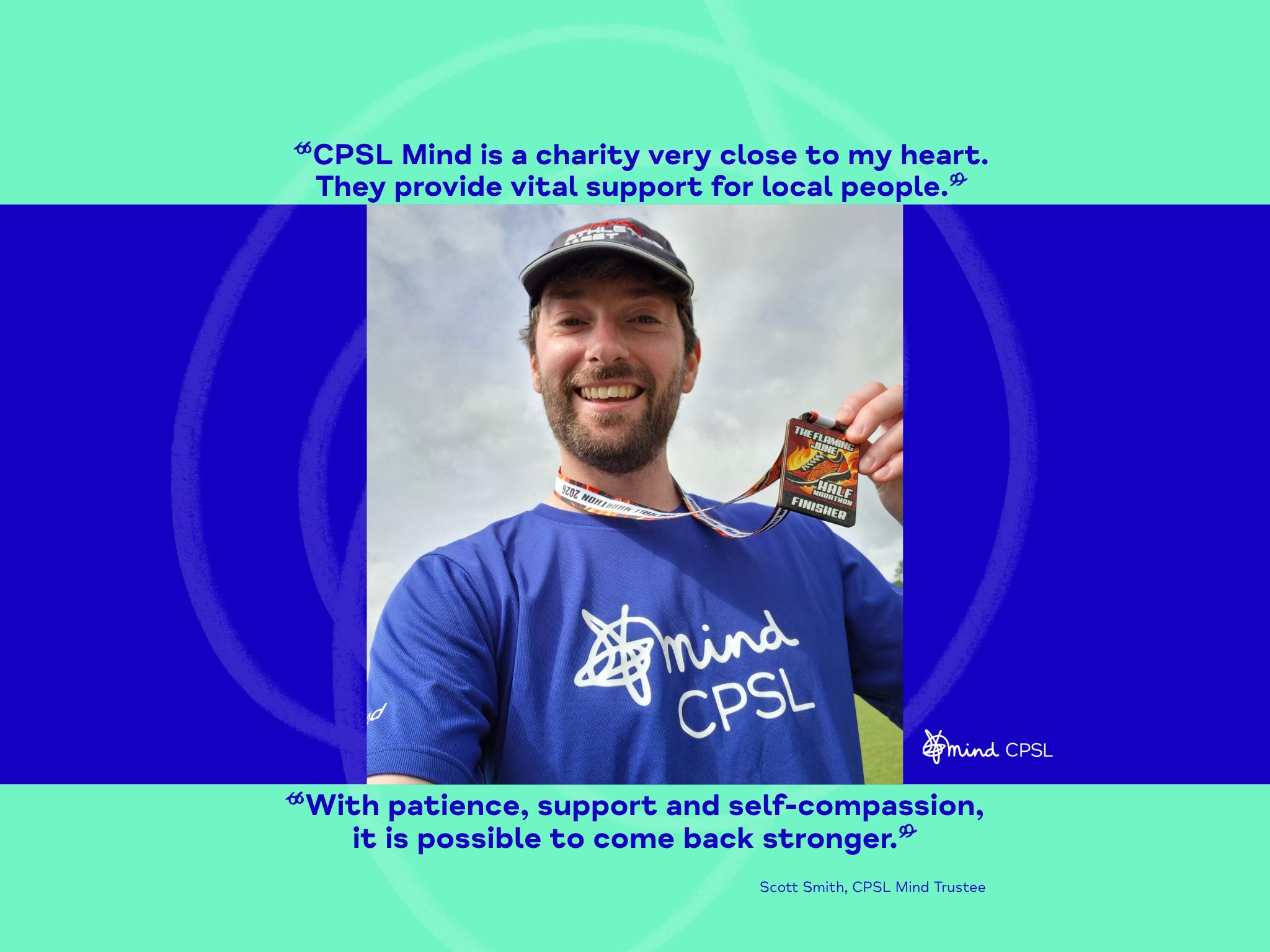
Scott Smith is a CPSL Mind trustee and long-time supporter of the charity, as well as someone who has found running to be an important part of both his physical and mental wellbeing. When he signed up for the Cambridge Half Marathon, it was both a personal challenge and an opportunity to fundraise for CPSL Mind, helping to support local people at a time when mental health services are under increasing pressure.
Although Scott usually runs shorter distances, he occasionally signs up for half marathons as a way of challenging himself and pushing his limits. Choosing CPSL Mind as his fundraising charity was an easy decision, reflecting both his role as a trustee and his commitment to supporting mental health services in the local community.
Running as a support for mental health
For Scott, running is closely tied to how he manages his own mental wellbeing.
“It helps SO much,” he explains. “I find it a great way to de-stress after a long day at work, great for clearing my head when I need space to process stuff, and I find it helps regulate my mood generally. My mood is always better in the weeks where I run a few times compared to the weeks where I don’t.”
Running regularly gives him structure, space and a sense of balance, particularly during busy or stressful periods.
Training for the Cambridge Half Marathon
In the build-up to race day, training had been going well. Scott was building momentum and preparing steadily for the challenge ahead. But just three weeks before the Cambridge Half Marathon, things changed.
He began to notice a niggle in his ankle during training. At first it seemed manageable, but over the next couple of runs the pain worsened significantly, eventually reaching the point where even walking became painful.
A visit to the physiotherapist confirmed shin splints, and Scott was advised not to run.
The disappointment of a setback
The news was incredibly difficult to process.
“I was really disappointed,” Scott says. “I felt like I’d let everyone down, and felt guilty that I wouldn’t be running when so many generous people had donated. I was also sad to miss the run itself as it is such an amazing event, the crowds are great and the atmosphere is always fantastic.”
Like many runners preparing for a big event, the race itself had become something he was looking forward to not just physically, but emotionally and socially too. Missing it felt like a significant setback.
Adjusting and focusing on recovery
Despite the disappointment, Scott focused on what he could control: recovery and wellbeing.
He started by going for slow walks with his dog, which helped him stay gently active and spend time outdoors without aggravating his injury. Alongside this, he committed fully to his physiotherapy exercises, focusing on giving his body the best chance to recover.
As time went on and his symptoms improved, he gradually reintroduced short, gentle runs. From there, he slowly built up distance and pace over the following months, taking a careful and patient approach to returning to running.
Learning to listen to his body
Looking back, Scott recognises how important it was to take the injury seriously, even when it was frustrating to step back from training.
“So many people I spoke to agreed that I’d done the right thing,” he says. “Although it was a tough decision, I’m glad I listened to the advice as it meant I could recover properly and get back to running sooner. If I’d pushed myself to run on the day I could have done serious damage.”
The experience reinforced the importance of rest, patience and self-compassion, especially when goals don’t go to plan.
Completing the half marathon in Histon
“I still wanted to complete the half marathon as I felt a sense of duty to do so.” Scott says. So, more than six months after first beginning his training journey, Scott was able to complete his half marathon in Histon instead.
The experience came with a powerful sense of closure and achievement.
“Honestly, it felt incredible,” he says. “I felt a huge wave of pride that I’d finally done it. I also felt a bit of relief that I’d got around injury free.”
He had been targeting a sub 1hr 50 finish time for several years without success, and finally achieving it made the moment even more meaningful.
“I’d been targeting a sub 1hr50 time for the last few years and never managed it, so to get there this time around after such a long rollercoaster of a journey was amazing.”
What the experience taught him
The experience of training, injury and recovery has stayed with Scott well beyond race day.
For anyone going through a similar setback, his advice is simple: give yourself grace and take your time.
“It can be tempting to push yourself but actually taking time to rest is important.”
More broadly, the experience reshaped how he thinks about rest and recovery in everyday life.
“That resting isn’t a waste of time, it’s vital. Whether that’s a rest day in a training plan for a half marathon or a quiet day at home to recover from a busy week of work.”
Supporting CPSL Mind
As a CPSL Mind trustee, Scott’s commitment to the organisation remains a central part of his motivation for running and fundraising.
“It’s important to be helping in any way I can so running for CPSL Mind is just another way I can do that.”
Through his fundraising efforts, Scott raised over £725, supporting our work across local communities.
Looking ahead
Scott’s journey with running is far from over. We have reserved him a place in the Cambridge Half Marathon next year, giving him another opportunity to take on the challenge and continue combining his personal goals with fundraising for a cause close to him.
Final reflection
Looking back on the whole experience, Scott describes feeling fortunate to have recovered and returned to running in a positive way.
“I feel so lucky to have recovered the way I did and it’s always a privilege to run for CPSL Mind.”
His journey is a reminder that setbacks are often part of progress, and that with patience, support and self-compassion, it is possible to come back stronger.
If you’d like to take part in the Cambridge Half Marathon in 2027, or the Great Eastern Run in October 2026, or you want to take on your own fundraising challenge, please get in touch at: fundraising@cpslmind.org.uk.